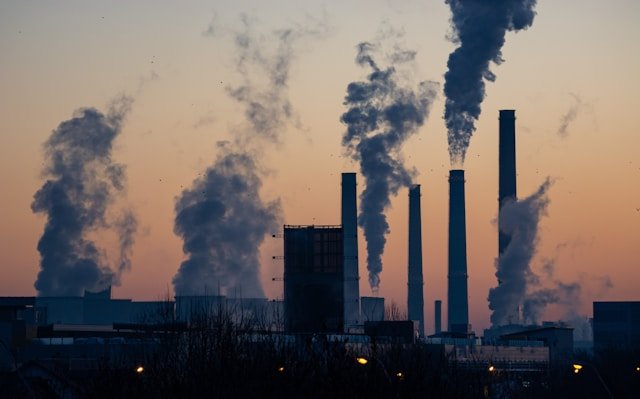
City air leaves invisible traces on your scalp.
Every walk through traffic or daily commute exposes your hair to microscopic particles that cling to oil, sweat, and skin cells.
Over time, this invisible layer can disrupt scalp balance — causing dryness, oiliness, and dullness to appear at once.
Pollution doesn’t just dirty your hair — it changes it. 🌿
What’s in Urban Air — and Why It Matters
Air pollution is a mix of PM2.5 (fine particles), heavy metals, smoke residues, and nitrogen oxides.
These particles are small enough to penetrate scalp pores and hair cuticles.
Once inside, they:
- Generate free radicals (oxidative stress)
- Break down natural lipids and proteins
- Trigger inflammation and itching
- Disrupt microbiome balance, favoring irritation-causing bacteria (Han & Kim, 2021)
Your scalp becomes caught in a silent imbalance — producing more oil to protect itself while simultaneously drying out.
1. The Oxidative Chain Reaction
Pollution exposure increases the scalp’s oxidative load — meaning more free radicals than antioxidants can neutralize.
These radicals attack both sebum and keratin, weakening follicle cells and barrier structure.
Symptoms of oxidation imbalance:
- Dull, brittle strands
- Greasy roots but dry ends
- Tightness or tingling scalp sensation
- Fading hair color (natural or dyed)
💡 Think of oxidation as “slow sunburn” from the air — unseen, but cumulative.
2. The Barrier Breakdown
When oxidative stress damages the lipid layer, the scalp loses its ability to seal in hydration.
This triggers a chain of compensatory reactions:
- Overproduction of oil (seborrhea)
- Increased sensitivity
- Micro-inflammation around follicles
This imbalance leads to temporary shedding — especially in already fragile or postpartum scalps.
Read more: Strengthening the Scalp Barrier After Postpartum Shedding
3. Pollution and the Microbiome
Pollutants disturb the balance between beneficial and pathogenic bacteria on the scalp.
When healthy microbes are outnumbered, irritation, odor, and dandruff-like symptoms appear.
To restore harmony, care should focus on prebiotic nourishment rather than antibacterial stripping.
Gentle microbiome rebuilders:
- Inulin and lactobacillus ferments
- Mild surfactants (no sulfates)
- pH-balanced cleansing (4.5–5.5)
Read more: How Prebiotics and Gentle Cleansing Support Hair Vitality
4. Pollution’s Effect on Hair Fibers
Fine particles and smoke residues stick to the hair shaft, roughening the cuticle surface.
This not only makes hair appear dull and dry, but also increases friction and breakage.
Protective measures:
- Rinse daily with lukewarm water after outdoor exposure
- Use antioxidant serums with vitamin E, green tea, or niacinamide
- Limit heavy silicones that trap pollutants instead of repelling them
5. The Urban Recovery Routine
To rebalance your scalp and hair from daily exposure:
| Step | Action | Purpose |
|---|---|---|
| 1 | Gentle wash (pH 5 shampoo) | Removes surface residue |
| 2 | Enzyme exfoliation (2–3×/month) | Clears deeper buildup |
| 3 | Antioxidant tonic | Neutralizes free radicals |
| 4 | Lipid serum or lightweight oil | Rebuilds barrier protection |
| 5 | Weekly massage | Improves circulation & detoxification |
💡 Consistency — not intensity — is what restores equilibrium.
Read more: Clay, Salicylic Acid, and Enzymes: The Gentle Exfoliators That Work
6. Postpartum and Urban Scalp Stress
Postpartum women living in cities face dual stressors: hormonal imbalance and pollution exposure.
Cortisol spikes amplify inflammation, while lipid depletion weakens barrier defense.
This combination makes gentle, antioxidant-rich care essential during recovery.
Protect and rebalance naturally:
👉 Gentle Postpartum Hair Recovery Guide
7. Ingredients That Defend Against Pollution
| Ingredient | Function | Source |
|---|---|---|
| Vitamin E | Neutralizes oxidative damage | Natural oils, tocopheryl acetate |
| Green Tea Extract | Calms inflammation | Camellia sinensis leaf |
| Niacinamide (B3) | Strengthens barrier, regulates sebum | Vitamin complex |
| Sea Buckthorn Oil | Omega repair, shields lipids | Plant-based |
| Panthenol (B5) | Restores hydration | Botanical provitamin |
These ingredients form a pollution-defense shield for both scalp and strands.
Restoring Balance: From Environment to Within
Pollution is inevitable — imbalance is not.
By reinforcing your scalp’s natural barrier, supporting its microbiome, and protecting against oxidative stress, you can thrive even in the busiest cities.
Gentle care isn’t weakness — it’s resilience made visible. 🌸
References
Han, J., & Kim, D. (2021). Airborne particle exposure and scalp lipid oxidation: implications for barrier repair. International Journal of Cosmetic Science, 43(5), 498–511.*
Lopez, C., Park, Y., & Lee, H. (2020). The effect of particulate matter on scalp microbiota and sebum oxidation. Journal of Cosmetic Dermatology, 42(4), 422–434.*