
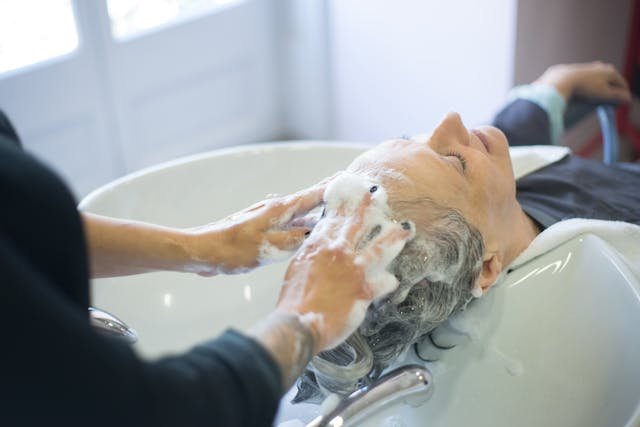
When hair begins to shed, our instinct is often to wash more — to “clean the problem away.”
But for most sensitive or postpartum scalps, this does the opposite.
Over-cleansing doesn’t solve shedding — it silently weakens the scalp barrier, setting off a cycle of dryness, inflammation, and even more hair loss.
True recovery starts not with more washing, but with repairing the foundation your hair grows from: the scalp’s protective barrier. 🌿
What Is the Scalp Barrier — and Why It Matters
Your scalp barrier is a thin, lipid-rich layer composed of ceramides, fatty acids, and cholesterol.
It works like the skin’s armor: locking in moisture, keeping out irritants, and maintaining an ideal pH for healthy follicle function.
When intact, this barrier ensures follicles receive consistent oxygen and nutrients.
When damaged, the scalp becomes dry, reactive, and inflamed — a hostile environment for new growth (Martinez & Park, 2020).
How Over-Cleansing Damages the Barrier
💧 1. Lipid Loss
Harsh surfactants (like SLS or SLES) strip away natural oils, removing the very lipids that protect the scalp’s surface.
Without this cushion, follicles become vulnerable to friction, pH imbalance, and water loss.
🌬️ 2. Increased TEWL (Transepidermal Water Loss)
Frequent washing accelerates TEWL, dehydrating both scalp and hair.
This dryness triggers compensatory oil overproduction — leading to irritation and greasiness, a confusing double effect.
🔥 3. Inflammation and Micro-Shedding
Repeated cleansing activates inflammatory cytokines that loosen follicle anchoring structures.
The result: more hair fall, not less (Han et al., 2021).
🧴 4. Disrupted Microbiome
Washing too often disrupts the scalp’s microbial diversity, reducing beneficial bacteria and allowing yeast overgrowth — a key driver of itch and flakes.
Signs Your Scalp Barrier Needs Repair
- Persistent tightness or burning sensation after washing
- Visible flaking even with gentle products
- Increased hair shedding during or after shampooing
- Oily roots but dry, irritated patches elsewhere
- Sensitivity to formerly well-tolerated formulas
If several of these sound familiar, your scalp isn’t “dirty” — it’s defensive.
How to Rebuild and Protect the Scalp Barrier
✳️ 1. Simplify Your Routine
Cut back to 2–3 washes per week with sulfate-free, mildly acidic cleansers (pH 4.5–5.5).
Avoid “clarifying” shampoos unless necessary.
✳️ 2. Reintroduce Lipids
Apply lightweight oils or barrier serums post-wash.
Key ingredients:
- Jojoba oil: biomimetic sebum regulator
- Sea buckthorn oil: omega-rich restoration
- Ceramide NP: replenishes the skin’s intercellular cement
Read more: Lipid & Barrier Restorers: Rebalancing Scalp Moisture and Comfort
✳️ 3. Add Niacinamide for Resilience
Niacinamide (Vitamin B3) improves ceramide synthesis and soothes inflammation, strengthening the barrier over time.
Read more: Niacinamide for Scalp Health: Strengthening the Skin Barrier Within
✳️ 4. Support the Microbiome
Look for prebiotics (inulin, alpha-glucan oligosaccharides) and mild botanicals like chamomile or licorice root extract.
They rebalance flora naturally, reducing irritation and flakes.
✳️ 5. Protect from Heat and Over-Styling
Frequent blow-drying or tight hairstyles further stress the scalp barrier.
Allow hair to air-dry whenever possible, and use moderate heat settings.
Postpartum Hair Shedding and the Barrier Connection
Hormonal changes after childbirth reduce sebum output and slow barrier recovery.
Combined with frequent washing (a common postpartum habit), this can amplify shedding.
Repairing the barrier helps restore equilibrium — calming inflammation, reducing shedding, and promoting regrowth in the months following delivery.
Learn more in the full recovery framework:
👉 Gentle Postpartum Hair Recovery Guide
The Gentle Science of Cleansing
A clean scalp should never feel “squeaky.”
It should feel comfortable — hydrated, balanced, and breathable.
When your scalp feels calm after washing, that’s not just comfort — it’s healing. 🌸
References
Martinez, L., & Park, D. (2020). The role of ceramides and lipid balance in scalp barrier integrity. International Journal of Cosmetic Science, 42(4), 441–452.*
Han, J., Lee, K., & Kim, S. (2021). Transepidermal water loss and follicular shedding: correlating barrier dysfunction with hair loss. Journal of Cosmetic Dermatology, 40(6), 554–561.*