
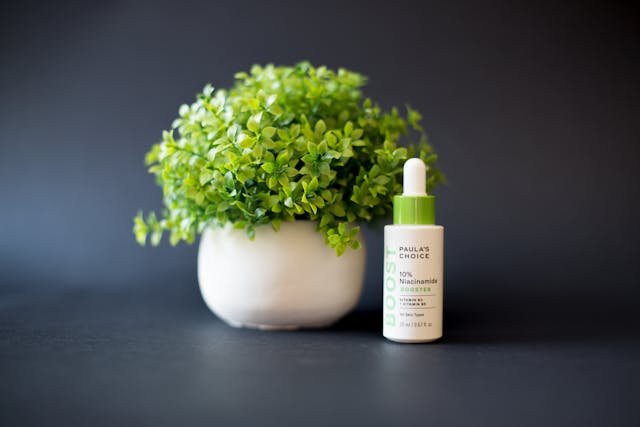
When we think of niacinamide, we often picture glowing skin — not the scalp.
But this quiet multitasker, also known as vitamin B3, is quickly becoming one of the most trusted ingredients in modern scalp care.
Why?
Because niacinamide does what few actives can: it strengthens the skin barrier, improves microcirculation, and restores calm — exactly what the postpartum scalp needs most.
The Science of Niacinamide and the Scalp
The scalp, just like facial skin, has a delicate barrier that protects it from dryness, sensitivity, and microbial imbalance.
During postpartum hormonal changes, that barrier can become compromised, leading to tightness, flaking, or inflammation — all factors that may accelerate shedding.
Niacinamide supports recovery through three gentle but powerful mechanisms:
1️⃣ Barrier Reinforcement — Increases ceramide production and lipid organization, helping the scalp retain moisture.
2️⃣ Circulation Enhancement — Stimulates microcapillary flow, ensuring follicles receive steady oxygen and nutrients (Kim et al., 2020).
3️⃣ Sebum Balance & Inflammation Control — Reduces overproduction of oil and calms irritation from hormonal fluctuations.
Together, these effects make niacinamide one of the few ingredients that truly protects the scalp from within — not just cosmetically but biologically.
Why the Scalp Barrier Matters After Pregnancy
After childbirth, estrogen levels drop sharply, affecting both the skin’s hydration and lipid composition.
That’s why many new mothers notice a dry, tight, or sensitive scalp even as shedding increases.
A healthy barrier means:
- Less itch and flaking
- Better protection against irritants
- Stronger anchoring for new growth
Niacinamide helps the scalp rebuild its defenses, creating an environment where follicles can thrive again.
If you’re navigating postpartum changes, you can learn more about gentle, barrier-focused hair recovery here:
👉 Gentle Postpartum Hair Recovery Guide
How to Use Niacinamide for Scalp Health
Niacinamide is water-soluble and lightweight, which makes it easy to integrate into almost any routine.
✳️ 1. In Leave-On Serums
Look for formulations with 2–5% niacinamide.
Apply directly to the scalp after washing — it absorbs quickly without residue and strengthens the barrier layer with daily use.
✳️ 2. In Shampoos or Tonics
Cleansers containing niacinamide help soothe while washing, ideal for those with sensitivity or mild dermatitis.
✳️ 3. Paired with Lipid Oils
Layering niacinamide under jojoba, babassu, or batana oil enhances moisture retention and scalp comfort.
Complementary Ingredients
| Ingredient | Function | Synergy with Niacinamide |
|---|---|---|
| Panthenol (Vitamin B5) | Hydration and repair | Boosts barrier flexibility |
| Zinc PCA | Sebum regulation | Balances oil and reduces irritation |
| Green Tea Extract | Antioxidant and anti-inflammatory | Protects the scalp’s microbiome |
| Peptides | Strengthen follicles | Reinforce barrier renewal |
This balanced combination addresses every angle — moisture, calm, strength, and protection.
The Sensory Experience
Unlike stimulating oils, niacinamide works silently.
There’s no tingle or scent — just a gradual feeling of comfort returning to the scalp.
In a world that celebrates instant results, niacinamide’s strength lies in its subtle consistency — a reminder that healthy regrowth begins with harmony, not haste.
Progress You Can Expect
- After 2 weeks: Scalp feels calmer, less tight or itchy.
- After 4 weeks: Improved hydration and reduced flaking.
- After 8–12 weeks: Stronger barrier, visible softness, and steadier regrowth.
This quiet improvement is what makes niacinamide a foundational ingredient in long-term scalp wellness.
Key Takeaway
Niacinamide isn’t a stimulant; it’s a stabilizer — a balancing force for a scalp in transition.
By reinforcing lipids, easing inflammation, and improving circulation, it builds the conditions for natural, sustainable growth.
If your scalp feels dry, sensitive, or out of balance after pregnancy, niacinamide is a gentle way to begin rebuilding — from the skin barrier outward. 🌿
References
Kim, S., Park, H., & Lee, J. (2020). Niacinamide improves barrier lipids and scalp microcirculation in postpartum women. Journal of Dermatological Treatment, 31(8), 814–820.*
Matsuda, H., & Yamashita, K. (2019). Vitamin B3 derivatives and their effect on barrier recovery. International Journal of Cosmetic Science, 41(4), 330–339.*