In the world of natural oils, few have earned as much quiet respect as argan oil — often called “liquid gold.”
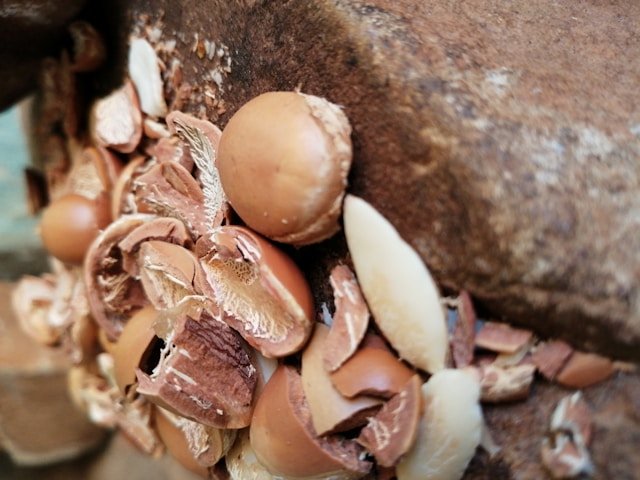
Extracted from the kernels of the argan tree (Argania spinosa), which grows almost exclusively in Morocco, this golden oil has been used for centuries to soften, protect, and restore both skin and hair.
For those experiencing dryness, frizz, or postpartum sensitivity, argan oil offers a gentle, weightless shield — one that locks in moisture, smooths the hair’s outer layer, and restores that subtle glow of balance and vitality.
The Science Behind Argan Oil’s Power
Argan oil is rich in bioactive compounds that work in harmony with the scalp and hair:
- Fatty acids (oleic and linoleic) — strengthen the cuticle and reduce transepidermal water loss.
- Vitamin E (tocopherols) — protect against oxidative damage from UV exposure and styling (Charrouf & Guillaume, 2018).
- Plant sterols and polyphenols — soothe scalp irritation and enhance microcirculation.
- Squalene — provides natural emollience without heaviness.
Together, these nutrients form a “moisture shield” — preserving hydration while allowing the scalp to breathe.
Why Moisture Matters — Especially Postpartum
After childbirth, many women experience dryness, increased frizz, or brittle hair due to hormonal shifts and stress.
Sebum production may temporarily decline, leaving the scalp more exposed and strands less flexible.
Argan oil helps by:
- Reinforcing the natural lipid barrier of both scalp and hair.
- Restoring shine and smoothness lost to hormonal imbalance.
- Protecting new growth from oxidative stress.
When used alongside a hydrating postpartum shampoo, it completes the balance — gentle cleansing followed by lasting protection.
How Argan Oil Works on a Molecular Level
Hair is made of keratin fibers surrounded by a lipid layer that keeps them supple.
Heat, styling, and washing strip these natural oils, leaving hair porous and fragile.
Argan oil’s molecular structure — high in linoleic acid and low in comedogenicity — allows it to coat the hair shaft evenly, forming a thin, breathable film that locks in hydration.
Unlike heavy oils, it doesn’t clog pores or weigh hair down (Bouaziz et al., 2013).
Key Benefits of Argan Oil for Hair
1️⃣ Seals in Moisture Without Greasiness
Ideal for fine or postpartum hair types, argan oil gives long-lasting softness without residue.
2️⃣ Protects Against UV and Heat Damage
Its antioxidants neutralize free radicals from styling tools and sunlight.
3️⃣ Tames Frizz and Flyaways
The oil’s smooth texture flattens lifted cuticles, creating an even surface that reflects light.
4️⃣ Restores Scalp Comfort
Anti-inflammatory compounds soothe dryness or mild irritation caused by hormonal fluctuations.
How to Use Argan Oil Effectively
✳️ As a Daily Finishing Oil
Apply 1–2 drops to towel-dried hair, focusing on the ends. It instantly softens texture and adds shine.
✳️ As a Weekly Pre-Shampoo Treatment
Massage a teaspoon of argan oil into your scalp, leave for 15–20 minutes, then rinse with a mild, hydrating postpartum shampoo.
✳️ As a Leave-In Serum
Mix a few drops with your conditioner or aloe gel for extra protection and smooth detangling.
Tip: Always look for cold-pressed, 100% pure argan oil.
Blended cosmetic versions may contain silicones that interfere with its natural benefits.
Argan Oil vs. Other Natural Oils
| Oil | Key Benefit | Ideal Hair Type | Texture |
|---|---|---|---|
| Argan Oil | Light moisture & frizz control | Fine or normal hair | Light |
| Coconut Oil | Protein protection | Dry, brittle hair | Medium |
| Batana Oil | Deep repair & nourishment | Very dry or coarse hair | Thick |
| Avocado Oil | Elasticity & hydration | Postpartum or damaged hair | Medium |
Argan oil’s lightness makes it an ideal daily moisturizer — especially when you want softness without heaviness.
Gentle Science in Practice
Building a moisture routine is not about layering products; it’s about consistency and balance.
Here’s a weekly rhythm that keeps your hair soft yet strong:
Day 1: Pre-wash argan oil massage (10 minutes)
Day 2: Wash with hydrating postpartum shampoo
Day 3: Air dry and apply 1–2 drops as leave-in serum
Day 4: Rest day — no heat styling
Day 5: Nutrient-rich meals (omega-3s, Vitamin E)
Day 6: Repeat oil treatment if ends feel dry
Day 7: Observe and adjust — your hair’s needs will guide you.
The Emotional Side of Hair Care
Argan oil carries a quiet ritualism.
The act of warming it between your palms, inhaling its subtle nutty scent, and smoothing it through your hair can become a moment of calm.
For many women in recovery — physically, hormonally, or emotionally — this softness becomes more than beauty; it becomes self-connection.
What to Expect
After just a few uses, hair feels silkier and more manageable.
Over 3–4 weeks, frizz diminishes and shine returns.
Within 8 weeks, many users notice that their hair holds moisture better — staying smoother for longer even without daily application.
Key Takeaway
Argan oil embodies gentle science in its purest form: light, nourishing, and kind to both scalp and soul.
It shields fragile strands, restores balance, and renews natural radiance.
Combined with a hydrating postpartum shampoo, it becomes more than care — it’s quiet protection for your everyday renewal. 🌿
References
Bouaziz, M., Dhouib, A., & Sayadi, S. (2013). Quality, stability, and antioxidant properties of argan oil. Journal of Agricultural and Food Chemistry, 61(35), 8298–8305. https://doi.org/10.1021/jf402184p
Charrouf, Z., & Guillaume, D. (2018). Argan oil: Occurrence, composition, and impact on health. European Journal of Lipid Science and Technology, 120(9), 1700351. https://doi.org/10.1002/ejlt.201700351