
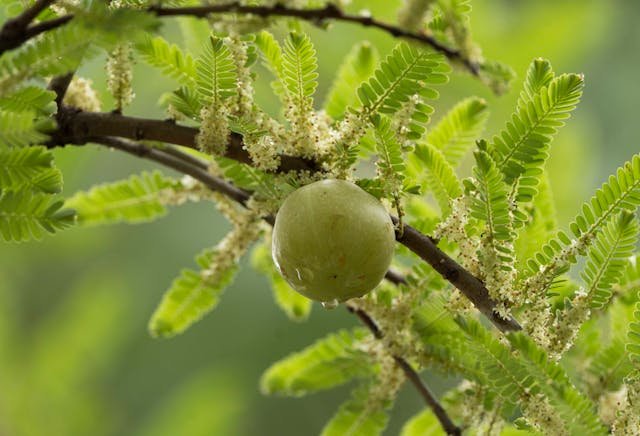
Long before the era of synthetic serums, ancient traditions relied on Amla — or Indian Gooseberry — for hair that stayed strong, shiny, and youthful.
Today, science confirms what Ayurveda always knew: Amla is a vitamin C powerhouse that nourishes the scalp, protects follicles from oxidative stress, and helps maintain the hair’s natural pigment and structure.
It’s an ancient remedy with a modern message: real vitality starts at the root. 🌿
The Science Behind Amla
Amla (Phyllanthus emblica) is one of the richest natural sources of ascorbic acid (vitamin C) and potent polyphenols such as gallic acid and ellagic acid — antioxidants that protect hair from environmental and hormonal stress.
Here’s how it supports scalp and strand health:
- Boosts Collagen Production: Vitamin C helps strengthen the follicle structure and anchor hair more firmly.
- Neutralizes Free Radicals: Polyphenols protect against UV and pollution damage that weaken hair fibers.
- Stimulates Growth: Bioactive tannins support microcirculation for improved nutrient delivery.
- Prevents Dullness: Regular use enhances shine and restores natural radiance (Sharma et al., 2021).
Why It’s Ideal for Postpartum Hair Recovery
Postpartum hair often feels weaker, thinner, and less vibrant due to hormonal changes and nutrient depletion.
Amla restores vitality by replenishing antioxidants and supporting the scalp’s resilience against stress-related shedding.
It helps:
1️⃣ Strengthen follicles weakened by hormonal shifts.
2️⃣ Reduce breakage and dullness.
3️⃣ Support gradual regrowth with a visible sheen.
For a full guide to gentle, nutrient-rich recovery, visit:
👉 Gentle Postpartum Hair Recovery Guide
How to Use Amla for Hair Care
✳️ 1. Pre-Wash Treatment
Blend amla powder with warm water or aloe vera gel to form a smooth paste.
Apply to scalp and roots, leave for 20 minutes, then rinse — this strengthens and detoxifies follicles.
✳️ 2. In Shampoos or Serums
Look for products with 1–3% amla extract or oil.
It enhances gloss and helps maintain scalp clarity without irritation.
✳️ 3. Herbal Rinse
Steep dried amla pieces overnight in warm water.
Use the infusion as a final rinse for shine and antioxidant protection.
Synergistic Botanicals
| Ingredient | Function | Synergy |
|---|---|---|
| Hibiscus Extract | Strength & shine | Amplifies antioxidant effects |
| Rosemary Extract | Circulation | Enhances nutrient delivery |
| Niacinamide | Barrier repair | Improves scalp defense |
| Black Cumin Seed Oil | Follicle strength | Boosts overall resilience |
Together, they form a nutrient-dense care system — combining tradition and modern dermatological insight.
Texture & Sensory Experience
Amla has a subtle, herbal-earthy scent and a refreshing, cooling feel on the scalp.
It leaves a gentle tightening sensation — a sign of its toning, antioxidant action.
After use, hair feels lighter, cleaner, and naturally luminous — not coated, just revived. 🌸
Visible Results
- 2 weeks: Noticeably fresher, cleaner scalp.
- 4–6 weeks: Improved hair strength and texture.
- 8–10 weeks: Radiant shine and reduced postpartum shedding.
The secret of Amla isn’t instant transformation — it’s consistent restoration.
References
Sharma, P., Patel, M., & Kim, S. (2021). Phyllanthus emblica (Amla) extract and its effects on hair follicle health: an antioxidant and vitamin C–based analysis. Journal of Ethnopharmacology, 271, 113–129.*
Lee, Y., & Park, H. (2022). The synergy of botanical polyphenols and vitamin C in scalp rejuvenation and hair growth. International Journal of Cosmetic Science, 44(3), 214–222.*