
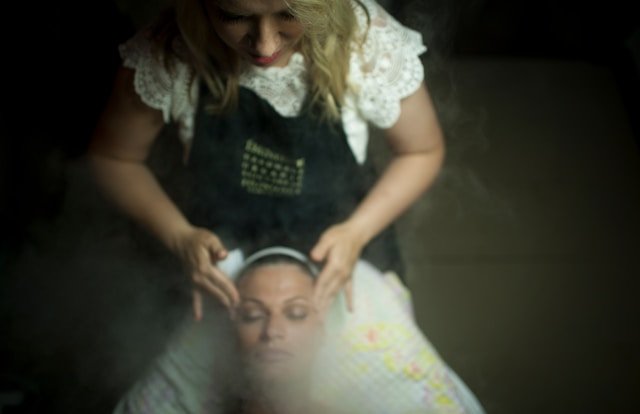
Touch is one of the most powerful ways to communicate safety — not just to the mind, but to the scalp.
Every gentle movement you make across your head sends signals that release tension, boost blood flow, and reduce stress hormones.
It’s more than relaxation — it’s restoration. 🌿
1. Why Circulation Matters
Your hair follicles depend on oxygen and nutrients delivered through tiny blood vessels called capillaries.
When circulation slows — from stress, posture, or tension — the scalp receives less nourishment, and follicles enter a “resting” phase.
Gentle massage reawakens these micro-channels, improving:
- Nutrient delivery to follicles
- Waste removal through lymphatic drainage
- Relaxation response, lowering cortisol
- Sebum distribution, preventing dryness or buildup (Han & Park, 2021)
💡 A few minutes of mindful touch can do more for scalp health than an extra product layer.
2. Preparing for Scalp Massage
You don’t need a spa to restore your scalp’s rhythm — just quiet, intention, and your fingertips.
Set the scene:
- Sit upright or recline with neck supported
- Warm your hands first; rub palms together to activate circulation
- Apply a few drops of lightweight oil (jojoba, babassu, or rosemary-infused blend)
- Take one slow breath before beginning
💡 If your scalp feels oily, you can massage dry — the warmth of your hands is enough.
3. Technique 1: Circular Root Activation
Goal: Stimulate blood flow and oxygen exchange around follicles
- Place fingertips (not nails) on your crown.
- Make slow circular motions, about the size of a coin.
- Move outward toward your temples, then down toward the nape.
- Keep pressure light — imagine rippling water, not scrubbing skin.
Duration: 2 minutes
Frequency: Daily or every other day
Read more: How Everyday Stress Creates Invisible Pressure on Your Follicles
4. Technique 2: Temple & Neck Release
Goal: Ease muscle tension and improve scalp mobility
- Place both thumbs at your temples.
- Massage in gentle outward circles for 20–30 seconds.
- Move fingers behind your ears, tracing down the neck.
- Gently press where your skull meets the neck — a key tension point.
Tip: Pair with slow exhalations to activate the parasympathetic nervous system — the body’s “calm mode.”
5. Technique 3: Lymphatic Sweep
Goal: Encourage detox and reduce scalp puffiness
- Use fingertips behind your ears.
- Sweep downward toward your collarbone with light strokes.
- Repeat 5–6 times each side.
This supports lymph drainage — helping your scalp stay clear and oxygenated.
6. Technique 4: Forehead-to-Crown Flow
Goal: Synchronize energy and calm the nervous system
- Start at the hairline of your forehead.
- Glide fingers gently back toward the crown in slow, symmetrical motions.
- Repeat 10–15 times while breathing deeply.
This simple movement helps release facial tension — and naturally supports scalp relaxation.
7. Oils and Ingredients That Support Circulation
| Ingredient | Function | Texture |
|---|---|---|
| Rosemary oil | Boosts microcirculation | Lightweight, aromatic |
| Ginseng extract | Revitalizes follicle metabolism | Tonic-like |
| Peppermint oil | Provides cooling, stimulating effect | Dilute before use |
| Babassu oil | Balances hydration without greasiness | Silky and neutral |
Combine 2–3 drops of essential oil with a tablespoon of carrier oil.
Test first if your scalp is sensitive.
Read more: Peppermint Oil and Scalp Energy: Cooling Care for New Growth
8. The Emotional Science of Touch
Gentle scalp massage triggers oxytocin, the hormone of calm connection.
It lowers cortisol, heart rate, and blood pressure — creating a physiological sense of safety that your follicles recognize.
In postpartum recovery, this calm state supports healing, hormonal balance, and hair regrowth.
👉 Gentle Postpartum Hair Recovery Guide
9. Routine for Real Results
| Routine Element | Duration | Best Time |
|---|---|---|
| Morning wake-up massage | 1 min | Boost circulation |
| Evening relaxation massage | 3–5 min | Calm stress, improve sleep |
| Weekly deep-oil ritual | 10–15 min | Strengthen barrier and soothe irritation |
Small, consistent gestures create visible transformation over time. 🌸
References
Han, Y., & Park, S. (2021). Scalp microcirculation and massage-induced vasodilation. International Journal of Cosmetic Science, 43(5), 512–524.*
Lopez, C., & Kim, J. (2022). Psychological stress and tactile stimulation in scalp wellness. Journal of Cosmetic Dermatology, 44(1), 78–90.*