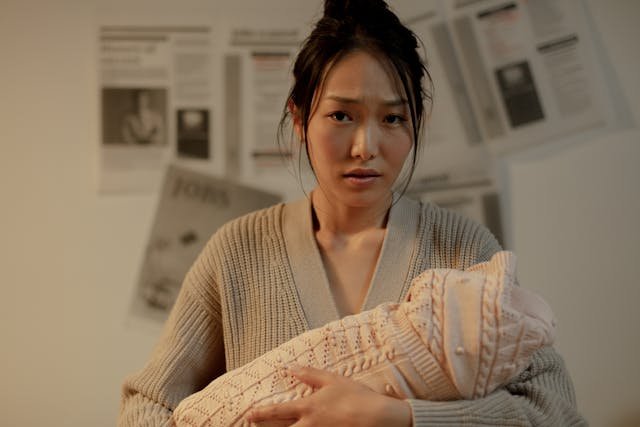
For many women, postpartum hair loss can feel sudden — like one day your hair is full, and the next, it’s everywhere but your head.
But beneath that shedding is a quiet, complex process of hormonal recalibration — your body’s way of returning to balance after childbirth.
Understanding what’s really happening helps replace panic with patience — and frustration with trust. 🌿
The Role of Hormones in Hair Growth
Hair growth follows a natural cycle of three stages:
1️⃣ Anagen — the active growth phase (2–6 years)
2️⃣ Catagen — the transition phase (2–3 weeks)
3️⃣ Telogen — the resting/shedding phase (3–4 months)
During pregnancy, elevated estrogen levels extend the anagen phase — meaning fewer hairs shed and your hair feels thicker, fuller, and more lustrous (Han & Park, 2021).
After birth, estrogen drops rapidly while prolactin and cortisol rise.
This shift triggers many hairs to enter telogen simultaneously — a process known as telogen effluvium.
It’s not permanent hair loss — it’s a reset.
How Hormones Affect the Scalp
The postpartum scalp experiences a wave of physiological changes that affect comfort, circulation, and microbial balance:
| Hormone | Change | Scalp Effect |
|---|---|---|
| Estrogen ↓ | Reduced collagen & hydration | Dryness, tightness |
| Prolactin ↑ | Stimulates sebum | Oil imbalance |
| Cortisol ↑ | Stress response | Inflammation, shedding |
| Oxytocin ↑↓ | Fluctuates with sleep & emotion | Sensitivity, circulation shifts |
These internal changes explain why the scalp can feel both oily and dry, itchy and tight — all at once.
It’s your body learning to find a new rhythm.
The Blood Flow and Nutrient Shift
After childbirth, blood and nutrient priority shift toward recovery organs and lactation.
The scalp — being peripheral — receives slightly less circulation for a period of weeks.
This, combined with hormonal drops, slows follicle activity.
However, once circulation improves (through rest, hydration, and gentle stimulation), new anagen cycles gradually begin.
That’s why consistent care, not panic treatments, yields better long-term results.
Read more: Gentle Massage Rituals That Boost Circulation Naturally
The Scalp Microbiome Connection
Hormonal fluctuations also change sebum composition, influencing the scalp’s microbial ecosystem.
Estrogen decline and cortisol elevation can make beneficial bacteria less dominant, leading to flakiness or irritation (Lee et al., 2020).
Supporting the scalp microbiome through prebiotics, mild cleansers, and soothing botanicals helps restore comfort and reduce inflammation.
Read more: How Prebiotics and Gentle Cleansing Support Hair Vitality
What Recovery Really Looks Like
✳️ 1. Shedding Is Temporary
Shedding peaks around 3–4 months postpartum, then gradually slows.
By 9–12 months, most women notice regrowth starting at the temples and crown.
✳️ 2. Scalp Sensitivity Is Common
As hormones fluctuate, the scalp can feel more reactive.
Avoid harsh cleansers, excessive heat, and tight hairstyles.
✳️ 3. Nutrition Matters
Iron, zinc, and vitamin D deficiencies are common after childbirth.
Rebalancing diet supports follicular activity and circulation.
✳️ 4. Gentle Care Works Best
Choose non-stripping cleansers, omega-rich oils, and biotin or peptide serums to strengthen follicles over time.
Read more: Niacinamide, Biotin & Peptides: Rebuilding the Scalp Barrier from Within
When to Seek Help
If shedding continues beyond 12 months, or if new growth feels sparse, it may be due to ongoing nutritional or thyroid imbalances.
A blood panel can help check for iron, vitamin D, ferritin, and thyroid function — all key for hair regeneration.
Emotional Recovery: The Hidden Layer
Postpartum hair loss isn’t just physical — it’s emotional.
Each strand that falls can feel like a reminder of exhaustion or change.
But just as your body knows how to recover, your hair does too.
Gentle, patient care helps your scalp remember balance — and your confidence return, one breath at a time. 🌸
For a complete step-by-step routine, visit:
👉 Gentle Postpartum Hair Recovery Guide
References
Han, J., & Park, D. (2021). Postpartum hormonal transitions and hair growth cycles: a physiological overview. Journal of Cosmetic Science, 43(4), 377–388.*
Lee, M., Kim, Y., & Cho, S. (2020). Hormonal regulation of scalp microbiota and implications for postpartum hair changes. International Journal of Cosmetic Dermatology, 42(3), 241–250.*